Archistory
HomeArchiveTime
Search
中文EN日本語

Archive

ArchitectsBuildingsTime

Periods

Classical EraMedievalRenaissanceBaroqueNeoclassicalIndustrial Revolution

Styles

Classical ArchitectureRenaissance ArchitecturePalladianismBaroque ArchitectureEnglish BaroqueMannerism

Search

Search architects or buildings...

Archistory © 2026
Archistory

Home/Architects/Louis Sullivan

Louis Sullivan

Portrait of Louis Sullivan, c. 1895

Portrait of Louis Sullivan, c. 1895

Unknown · Public Domain · Source

Louis Sullivan (1856–1924) is often called the "father of the skyscraper" and the first master of modern American architecture. His famous dictum "form follows function" influenced an entire century of design thinking. But Sullivan was far more than a slogan-maker: he defined the language of the tall building in post-fire Chicago, his cast-iron ornament approached botanical precision, and his late, lonely writings gave architecture philosophical depth.

Life span1856 – 1924Nationality / Region美国StyleChicago School, Early SkyscraperEducation麻省理工学院,巴黎美术学院
Chicago SchoolEarly Skyscraper
Portrait of Louis Sullivan, c. 1895

Portrait of Louis Sullivan, c. 1895

Unknown · Public Domain · Source

Ideas

01

Form follows function — but not functionalism. Function includes spiritual, emotional, and social needs, to which architecture should respond

02

The tripartite skyscraper — base (shops/public), shaft (repeating office floors), capital (mechanical/termination). This law governed tall buildings for a century

03

Organic ornament — ornament should not be applied pattern but must grow naturally from the building's structure and materials, like a plant's flower and leaf

04

Democratic architecture — Sullivan believed good architecture should not be an elite luxury but the foundation of everyday life in American cities

Architect dossier

03

01 / 03

Chicago: Birthplace of the skyscraper

The Great Chicago Fire of 1871 destroyed nearly the entire downtown but created unprecedented opportunity for a generation of architects. Steel-frame construction, elevators, and fireproofing matured, enabling buildings to grow upward. Young Sullivan, after working in William Le Baron Jenney's office, partnered with Dankmar Adler and began the decade that would define the skyscraper type.

The 1891 Wainwright Building is the first complete expression of Sullivan's mature skyscraper language. The red brick and terracotta façade is clearly divided into three horizontal zones: shop windows at the base, seven unified office window bands in the middle, and a decorative cornice at the top. Vertical pilasters pierce the middle floors, emphasizing upward movement. This "base—shaft—capital" tripartite composition became the default formula for tall buildings for decades.

02 / 03

The true meaning of "form follows function"

The slogan is often reduced to a functionalist doctrine, but Sullivan's intent was far more complex. In his 1896 essay "The Tall Office Building Artistically Considered," he wrote: "It is the pervading law of all things organic and inorganic, of all things physical and metaphysical, of all things human and all things superhuman — that form ever follows function. This is the law."

For Sullivan, "function" encompassed not only practical use but spiritual expression. A building must fulfill its practical purpose while also communicating a higher order through form. This is why he insisted on ornament on skyscrapers — not applied decoration but the natural flowering of structural logic at the surface. The cast-iron ornament at Carson Pirie Scott's corner entrance — curling tendrils, interwoven geometries — is the peak of Sullivan's ornamental philosophy: they mark the entrance, guide the eye, and give a steel-frame building a face.

03 / 03

Late years: The lonely genius and Frank Lloyd Wright

After 1900, Sullivan's career declined sharply. Chicago's taste turned toward Neoclassicism and historical styles; his organic ornament and modernist stance ceased to attract clients. His partnership with Adler ended in 1895, and major commissions dwindled. Yet it was in this marginal period that Sullivan produced two kinds of small masterpieces: a series of jewel-like banks across the Midwest, and a body of architectural-philosophical writings.

Sullivan's influence on Frank Lloyd Wright was profound. Wright worked in Sullivan's office for six years, called him "Lieber Meister" (Dear Master), and acknowledged throughout his life that his ideas on spatial flow and organic ornament came from Sullivan. Yet their fates diverged — Wright walked the long path of glory, while Sullivan spent his final years in poverty and alcohol. When he died in 1924 he was nearly forgotten, until modernist historians rediscovered his contribution and placed him as the irreplaceable origin in the genealogy of modern architecture.

Sections

  1. 01Chicago: Birthplace of the skyscraper
  2. 02The true meaning of "form follows function"
  3. 03Late years: The lonely genius and Frank Lloyd Wright

Reading the works

Wainwright Building

Wainwright Building

圣路易斯, 美国 · 1891

A manifesto of early skyscraper aesthetics — the tripartite façade defined the language of the tall building.

Wainwright Building→
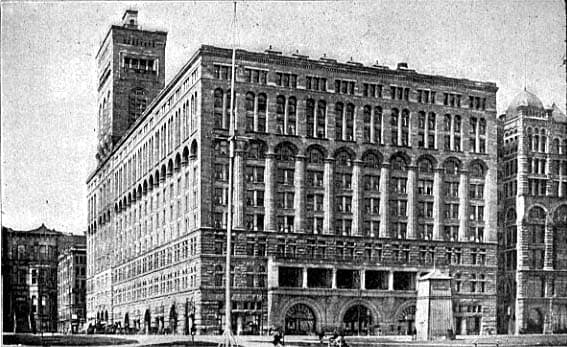
Auditorium Building

Auditorium Building

芝加哥, 美国 · 1889

A colossal mixed-use building combining theater, hotel, and offices — the peak of Sullivan & Adler.

Auditorium Building→
Carson Pirie Scott Building

Carson Pirie Scott Building

芝加哥, 美国 · 1904

Cast-iron tendrils at the corner entrance are the ultimate expression of Sullivan's organic ornament.

Carson Pirie Scott Building→

Sources

  • Encyclopaedia Britannica: Louis Sullivan
  • Wikidata: Louis Sullivan
  • The Art Institute of Chicago: Sullivan Collection
  • Sullivan, "The Tall Office Building Artistically Considered" (1896)

Related Architects

Influenced

Frank Lloyd Wright

1867–1959 · 现代主义大师

Works

3 buildings

1889Auditorium Building芝加哥, 美国
1891Wainwright Building圣路易斯, 美国
1904Carson Pirie Scott Building芝加哥, 美国

All works

Auditorium Building

Auditorium Building

芝加哥, 美国 · 1889

Carson Pirie Scott Building

Carson Pirie Scott Building

芝加哥, 美国 · 1904

Wainwright Building

Wainwright Building

圣路易斯, 美国 · 1891

Continue Exploring

Influenced

Frank Lloyd Wright1867 – 1959