01 / 03
Neues Museum: Architecture on a wound
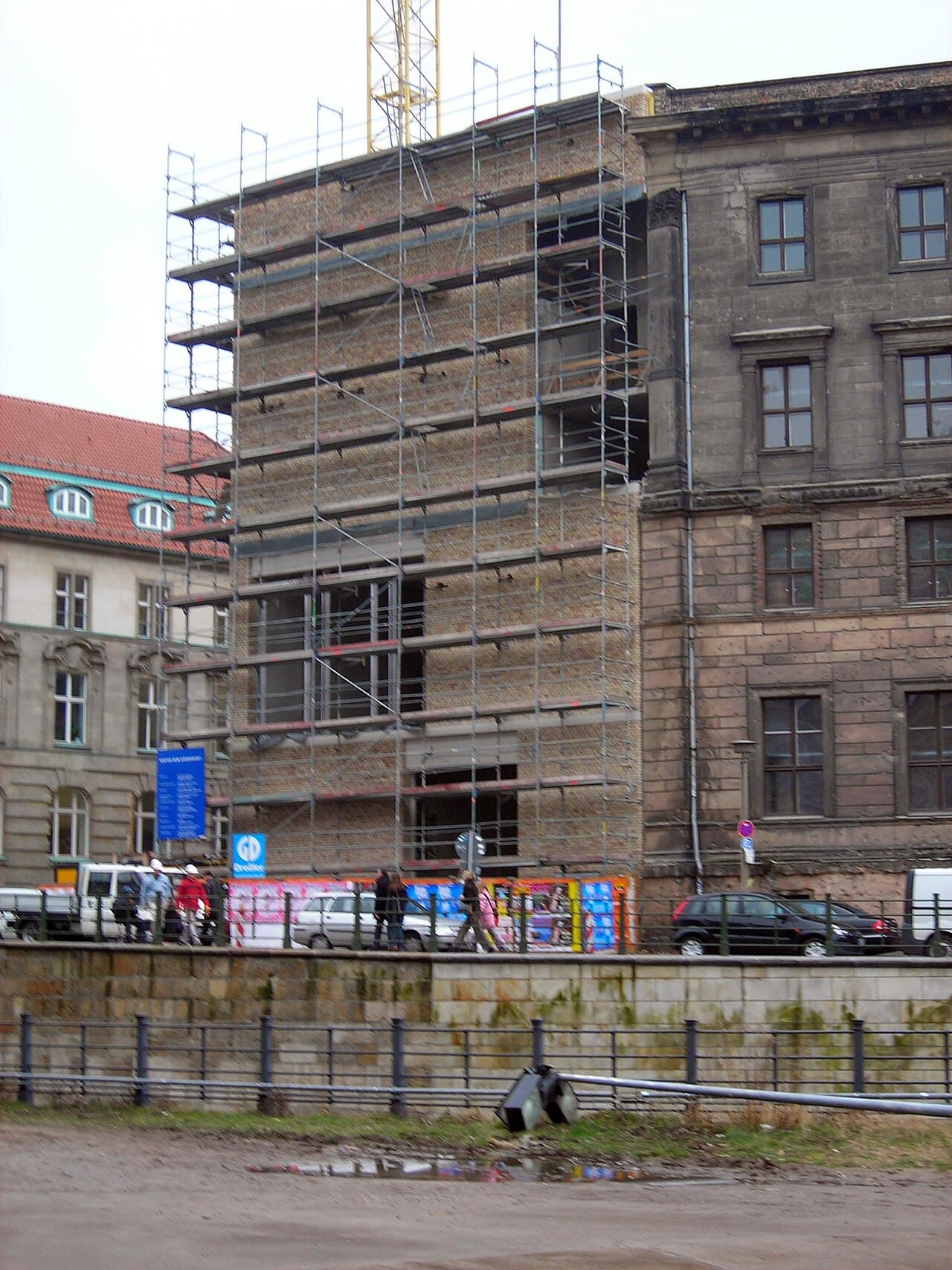
The Neues Museum in Berlin (1843–1855, designed by Friedrich August Stüler) was largely destroyed by aerial bombardment during WWII. For over half a century afterward, it stood as a ruin on Berlin's Museum Island — roof collapsed, stair hall completely vanished, murals covered in water stains and mold. In 1997, Chipperfield won the international competition to restore the building. This was no ordinary "restoration" project: the bombed-out ruin was not a mistake to erase but a "co-author" of the new architecture.
Chipperfield's methodology was termed "integrated repair." He did not attempt to return the building to its pre-war state (that would be a forgery), nor did he cap the ruin with an entirely new structure (that would be arrogance). He chose a third path: preserving and stabilizing all historical material — bullet-pocked brick walls, smoke-stained ceilings, faded mural fragments — and then filling gaps with precise but understated new material. New and old never merge: new colonnades use recycled brick and pale cement, forming a sober dialogue with surviving historical brickwork. The new stair hall uses clean white concrete and stone — simplified nearly to disappearance, so that the surviving mural fragments of Friedrich Wilhelm IV become the protagonists.
When it reopened in 2009, the Neues Museum triggered an unprecedented experience: a visitor sees simultaneously, within a single space, the layering of three eras — 19th-century classicism, the violence of 20th-century war, and the restrained repair of the 21st century. This is no longer "restoration" but "redaction" — Chipperfield behaved like a chronicler, allowing time to leave legible traces in the architecture. In this sense, the Neues Museum is one of the most profound answers to the question of "how to build in history" since the 20th century.