Archistory
HomeArchiveTime
Search
中文EN日本語

Archive

ArchitectsBuildingsTime

Periods

Classical EraMedievalRenaissanceBaroqueNeoclassicalIndustrial Revolution

Styles

Classical ArchitectureRenaissance ArchitecturePalladianismBaroque ArchitectureEnglish BaroqueMannerism

Search

Search architects or buildings...

Archistory © 2026
Archistory

Home/Architects/Peter Eisenman

Peter Eisenman

Portrait of architect Peter Eisenman

Portrait of architect Peter Eisenman

Peter Eisenman is the most important theoretical radical in contemporary architecture. Starting from deconstructivist philosophy, he regards architecture as a linguistic system capable of abstract thought and self-critique. His work — from the House series to the Berlin Holocaust Memorial — is never about comfort or beauty but about the very possibilities and limits of architecture itself.

Life span1932 – PresentNationality / RegionUnited States
Portrait of architect Peter Eisenman

Portrait of architect Peter Eisenman

Ideas

01

Architecture is not shelter — it is a form of writing, a text that can be read and rewritten

02

The traditional architectural assumptions of comfort, function, and beauty are all premises to be questioned, not self-evident truths

03

The displacement, rotation, and superimposition of grids can reveal hidden spatial orders

04

Absence and void are as important as presence and solidity

05

The horror of the Holocaust cannot be represented — architecture can only approach it by creating a sense of loss

Architect dossier

03

01 / 03

Architecture on Paper: The House Series and Architectural Autonomy

Peter Eisenman was born in New Jersey in 1932 and educated at Cornell, Columbia, and Cambridge. In the 1970s, he became the focus of architectural theory with the “House series” (House I–X). These ten numbered houses (four actually built) were not designed for living — they are experiments in architectural grammar. House VI (1975) is the most famous example: a virtual grid line inserted into the building disrupts the normal logic of floor slabs, columns, and walls — stairs interrupt in mid-air, columns fail to touch the ground, an impassable fissure runs through the middle of the bedroom.

The radicalism of the House series lies in its claim: architecture can be a completely self-consistent formal system, independent of the demands of function, climate, economy, even gravity. Eisenman introduced Chomsky’s linguistics and Derrida’s deconstruction into architecture, arguing that architectural form also possesses deep structures and transformational rules like language. These houses are not for “living in” — they are texts to be “read.”

Unsurprisingly, the actual relationships between these houses and their users (including the owner of House VI, an architectural photographer) were intensely fraught. The couple who owned House VI later wrote a book recounting the difficulties of living there: the bed had to straddle the fissure, the stairs were unusable, the dining table was pierced by a column. Eisenman was utterly unconcerned — for him, the discomfort of the users was precisely proof of architecture’s autonomy. Architecture could be as “difficult” as an abstruse philosophical essay.

02 / 03

The Berlin Memorial: How to Build Absence

If the House series was Eisenman’s theoretical laboratory, the Berlin Memorial to the Murdered Jews of Europe (2005) was his theory’s greatest test in the public realm. Across a 19,000-square-meter site, 2,711 concrete stelae of varying heights are arranged in an undulating grid. No names, no text, no narrative — only abstract volumes, sloping ground, and grayness gradually engulfing the visitor.

The memorial’s greatest power lies in its refusal to provide any explanation or consolation. You walk in; the stelae rise from ankle height to above your head; the ground begins to tilt; orientation vanishes; all that remains is gray gravity and the sound of your own footsteps. It is not a “memorial” in the traditional sense — more a spatial device that lets you bodily experience “disorientation” and “unease.” This is precisely the effect Eisenman intended: the horror of the Holocaust cannot be represented, but a kind of “heaviness of absence” can be constructed in space.

The memorial sparked fierce debate: some found it too abstract, too cold, lacking educational function; others saw it as one of the most powerful forms of commemoration precisely because it refuses to lecture. Whatever the case, it marks an important moment — deconstructivist architecture is not only valid in academies and galleries; it can function in the public realm of greatest moral weight.

03 / 03

Theory, Pedagogy, and the Boundaries of Architecture

Eisenman’s influence extends far beyond his built works. As a core member of the New York Five (alongside Richard Meier, Michael Graves, and others), he drove the turn toward theorization in architecture during the 1970s. The Institute for Architecture and Urban Studies (IAUS), which he founded, became the center of international architectural theory exchange. The journal Oppositions redefined the standard of architectural writing.

In teaching, Eisenman taught for decades at Princeton, Harvard, Yale, Cooper Union, and other institutions. His pedagogical approach was not to impart “how to design” but to continually ask “What is architecture?” “What can architecture do?” “Where lie the limits of architecture?” This Socratic method influenced generation after generation of architects, including later figures like Greg Lynn and many pioneers of the digital architecture field.

After the 2000s, Eisenman’s output of built works gradually declined, but his cultural stature remains secure. He continues to write, lecture, and comment as a public intellectual — one of the few “crossover” figures in architecture capable of exerting influence in both academia and mass media simultaneously. His intellectual legacy — that architecture can be text, can be self-critical, can serve no external function — still reverberates through the academy. His buildings may not be particularly “livable,” but the questions he raised remain ones that all serious architects must confront.

Sections

  1. 01Architecture on Paper: The House Series and Architectural Autonomy
  2. 02The Berlin Memorial: How to Build Absence
  3. 03Theory, Pedagogy, and the Boundaries of Architecture

Reading the works

Memorial to the Murdered Jews of Europe

Memorial to the Murdered Jews of Europe

2005

An abstract field of 2,711 gray concrete stelae with no text or explanation — only sloping ground and grayness slowly engulfing the visitor. Deconstructivism’s boldest practice in the public realm.

Memorial to the Murdered Jews of Europe→
Wexner Center for the Arts

Wexner Center for the Arts

1989

A collision of white scaffolding grids and a pseudo-historical red-brick fortress, where grid-system instability and displacement create an “uneasy architecture.”

Wexner Center for the Arts→
House VI

House VI

1975

A three-dimensional drawing sliced apart: stairs that vanish in space, columns that never reach the ground, a fissure running through the bedroom. Architecture not for living but for being thought.

House VI→

Sources

  • Eisenman Architects Official Site
  • Stiftung Denkmal — Holocaust Memorial
  • Wikidata: Peter Eisenman

Works

13 buildings

1975House VI
1989Wexner Center for the Arts
1996Untitled
2005Memorial to the Murdered Jews of Europe
?Q127603813
?Q118611433
?Q120491047
?State Farm Stadium
?Q125054375
?Q118611436
?Q118611444
?Q127603672
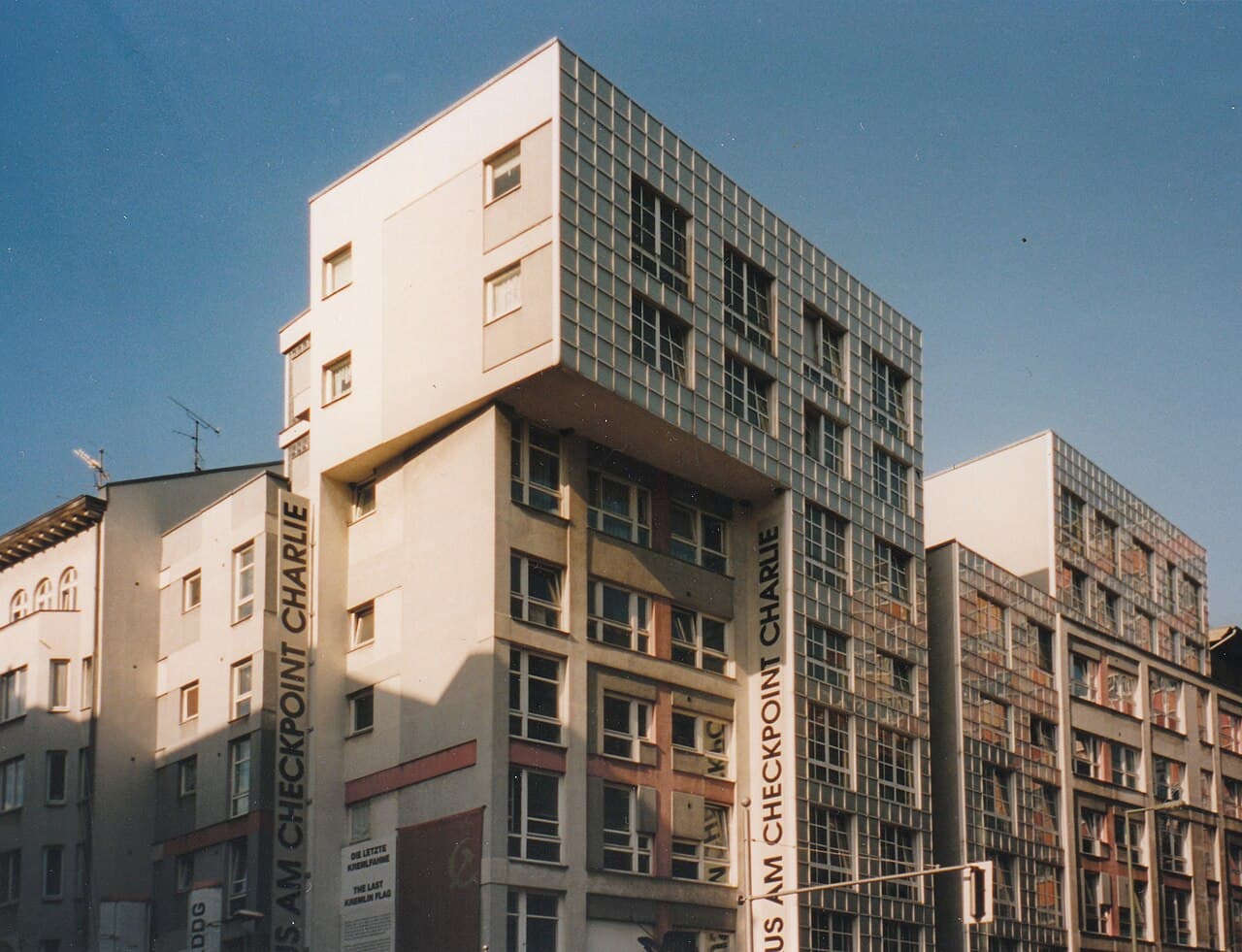
?Haus am Checkpoint Charlie

All works

Untitled

Untitled

House VI

House VI

1975

Memorial to the Murdered Jews of Europe

Memorial to the Murdered Jews of Europe

2005

Untitled

Untitled

Untitled

Untitled

State Farm Stadium

State Farm Stadium

Untitled

Untitled

Untitled

Untitled

Untitled

Untitled

Untitled

Untitled

Wexner Center for the Arts

Wexner Center for the Arts

1989

Haus am Checkpoint Charlie

Haus am Checkpoint Charlie

Untitled

Untitled

1996