Archistory
HomeArchiveTime
Search
中文EN日本語

Archive

ArchitectsBuildingsTime

Periods

Classical EraMedievalRenaissanceBaroqueNeoclassicalIndustrial Revolution

Styles

Classical ArchitectureRenaissance ArchitecturePalladianismBaroque ArchitectureEnglish BaroqueMannerism

Search

Search architects or buildings...

Archistory © 2026
Archistory

Home/Architects/Eladio Dieste

Eladio Dieste

Portrait of architect Eladio Dieste

Portrait of architect Eladio Dieste

Eladio Dieste was Uruguay’s genius engineer-architect. Quietly in South America, he built a series of elegant brick thin-shell structures — undulating roofs, self-supporting arch walls, Gaussian vaults — achieving the most astonishing structural spans with the humblest of materials: brick. His work proves that “low-tech” materials and “high-tech” thinking can create a poetry no reinforced concrete can replicate.

Life span1917 – 2000Nationality / RegionUruguay
Portrait of architect Eladio Dieste

Portrait of architect Eladio Dieste

Ideas

01

Brick is not just a filler material — it can become the structural protagonist capable of bearing large-span loads

02

Resisting gravity does not necessarily require mass — shape and geometry themselves can generate strength

03

Structural economy is not cutting corners but deep understanding of materials, form, and construction process

04

Architecture should be generous even to the poor — good space is not the privilege of the rich

05

Reinforced ceramic is a seriously underestimated structural possibility

Architect dossier

03

01 / 03

Uruguay’s Masonry Poet: An Architecture of the Possible

Eladio Dieste was born in Artigas, Uruguay in 1917 and graduated from the University of the Republic’s Faculty of Engineering in Montevideo in 1943. His career unfolded entirely within Uruguay — a small South American nation with neither the high-tech resources of developed countries nor big-project budgets. But precisely this “scarcity” catalyzed Dieste’s creativity: he had to use the cheapest local material (brick) and the most ordinary labor (local masons) to create extraordinary spaces.

Dieste’s core innovation lay in “reinforced ceramic”: embedding thin steel bars within brick masonry, transforming brick from a purely compressive material into one capable of resisting bending and tension. Combined with his unique shape designs — Gaussian vaults (double-curvature thin shells), self-supporting arch walls (self-balancing extra-long brick walls), and undulating roofs — he realized a series of structurally astonishing and elegant industrial buildings, churches, and markets.

From the 1960s through the 1990s, Dieste designed and built over 200 buildings, almost all in Uruguay. These works never appeared on the covers of mainstream architecture magazines, but everyone who has visited them in person has been awed by their power. He was not a “starchitect” pursuing self-expression — he was an engineer, a problem-solving craftsman, someone who believed that “the order of the universe can manifest from the order of bricks.”
02 / 03

Churches, Warehouses, and Gaussian Vaults

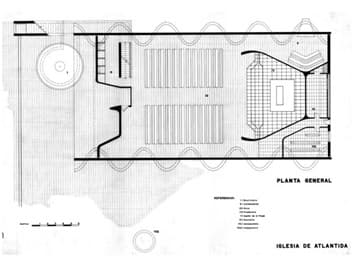
Dieste’s architectural language reached its highest spiritual realm in church design. The Church of Cristo Obrero y Nuestra Señora de Lourdes in Atlántida (1960) is his earliest and most famous work: a humble worship space composed of undulating brick walls and an undulating roof. The walls curve in two directions — simultaneously load-bearing walls and roof — forming a continuous, almost thickness-less shell. Sunlight seeps through subtle gaps between the bricks and a band of clerestory at the top, with patches of light slowly migrating across the interior walls. The church was inscribed as a UNESCO World Heritage site in 2021.

The Gaussian vault is another of Dieste’s structural masterpieces. This form is based on Carl Friedrich Gauss’s mathematical study of curved surfaces, using the double curvature of brick courses (curving simultaneously in two directions) to obtain rigidity. Dieste used extremely long-span Gaussian vaults in Montevideo Shopping (1985) — enormous brick shell roofs covering the entire market space without any intermediate support, the sequence of undulating crests like a churning ocean frozen overhead.

Dieste elevated industrial architecture to almost sacred heights. His warehouses, factories, and bus terminals — building types usually receiving the least architectural attention — became vessels of light in his hands. The interior of the Julio Herrera y Obes warehouse (1979) is a series of self-supporting brick arches, with daylight falling through skylights between the arch crests. He proved a proposition almost no one believed at the time: brick — one of humanity’s oldest building materials — can compete with steel and concrete in structural efficiency and aesthetic quality.

03 / 03

A Cosmology of Resistance: Material, Faith, and Society

Dieste’s architectural practice was inseparable from his deep Catholic faith. For him, the beauty of structure was not a decorative myth but the “manifestation of cosmic order” — a structure standing elegantly according to mathematical and physical laws is a testimony to the rationality of the Creator. This mode of thinking should not be misunderstood as religious mysticism — it is closer to Einstein’s “cosmic religious feeling” finding its counterpart in civil engineering: the beauty of natural law is itself sacred.

Dieste was a resolute “Third World” architect. He declined project offers and teaching positions from developed countries, choosing to stay in Uruguay and “build his own country” in his own way. His buildings did not serve multinational capital or high-end markets — churches were built for rural communities, warehouses for local commerce and industry. His “reinforced ceramic” technology made high-quality large-span public spaces affordable even for poor nations.

Dieste died in Montevideo in 2000 at age 82. His works barely crossed Uruguay’s borders during his lifetime. But since the 21st century, as architecture has renewed its attention to “modernism’s multiple possibilities” and “low-tech high-thought,” Dieste’s reputation has been rising rapidly worldwide. His architecture was incorporated by architectural historian Kenneth Frampton into the classic cases of “Critical Regionalism,” and the UNESCO recognition in 2021 marks his works’ entry from the regional into the pantheon of World Heritage. Dieste proved: an architect’s greatness lies not in the size of their country, the scale of their budget, or the attention of the media, but in the capacity to extract cosmic poetry from the humblest of conditions.

Sections

  1. 01Uruguay’s Masonry Poet: An Architecture of the Possible
  2. 02Churches, Warehouses, and Gaussian Vaults
  3. 03A Cosmology of Resistance: Material, Faith, and Society

Reading the works

Church of Cristo Obrero y Nuestra Señora de Lourdes

Church of Cristo Obrero y Nuestra Señora de Lourdes

1960

A UNESCO World Heritage site, where undulating brick walls are simultaneously load-bearing and roof, light seeping through brick gaps and skylights — the sacred transfiguration of humble material.

Church of Cristo Obrero y Nuestra Señora de Lourdes→
church of San Juan de Ávila

church of San Juan de Ávila

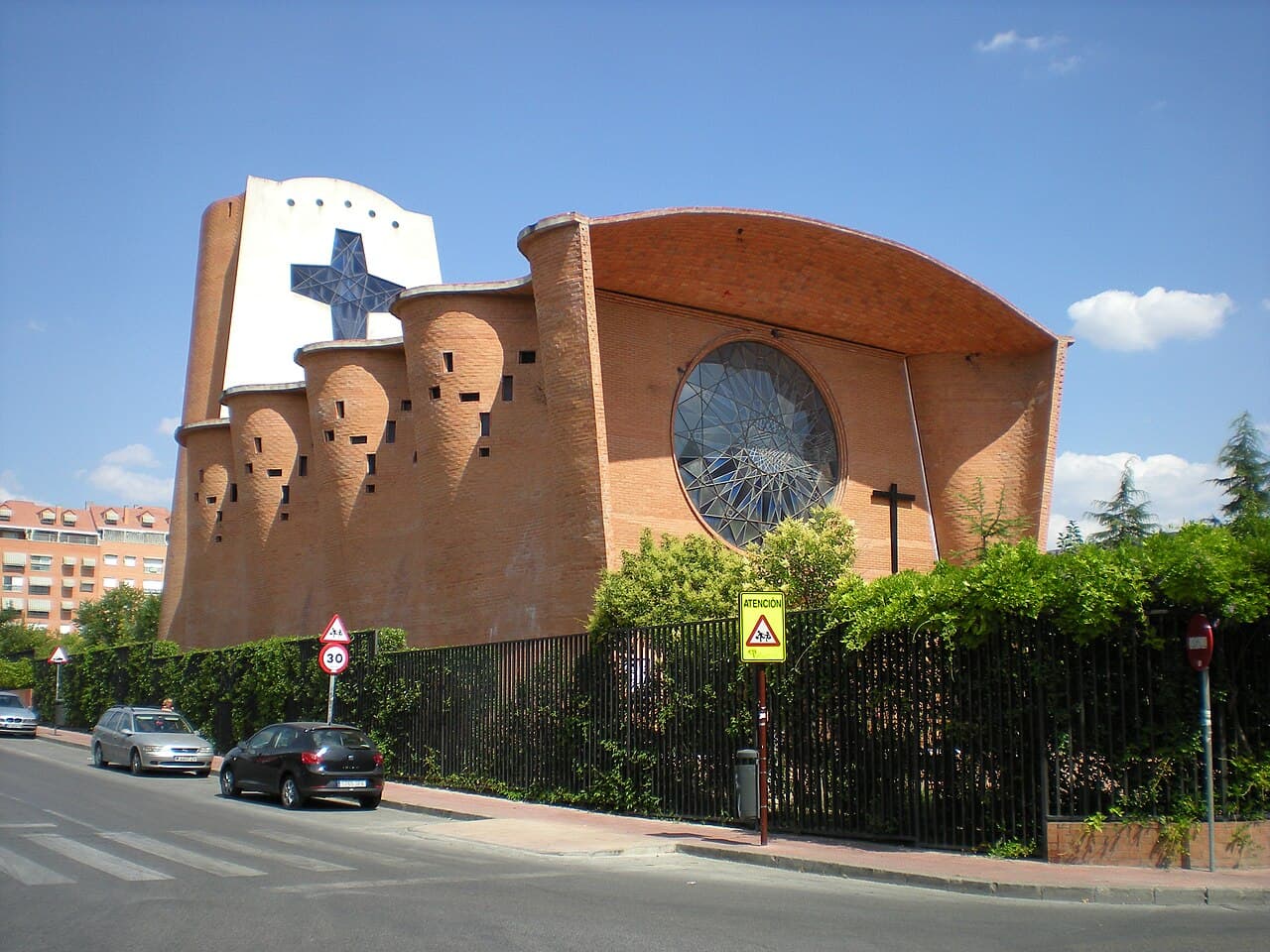
The interior of San Juan de Ávila Church is an ocean of brick — double-curvature vaults like spread wings, orange brick surfaces burning in sunlight.

church of San Juan de Ávila→
Montevideo Shopping

Montevideo Shopping

1985

The poetic surprise of commercial architecture: beneath enormous brick shell roofs, a shopping center becomes a vessel of light, proving that everyday architecture can also have a soul.

Montevideo Shopping→

Sources

  • Eladio Dieste — UNESCO World Heritage
  • Fundación Eladio Dieste
  • Wikidata: Eladio Dieste

Works

6 buildings

1929Parroquia Maronita de Nuestra Señora del Líbano
1960Church of Cristo Obrero y Nuestra Señora de Lourdes
1985Montevideo Shopping
?church of San Juan de Ávila
?Depósito Julio Herrera y Obes
?Nuestra Señora del Líbano, Montevideo

All works

church of San Juan de Ávila

church of San Juan de Ávila

Church of Cristo Obrero y Nuestra Señora de Lourdes

Church of Cristo Obrero y Nuestra Señora de Lourdes

1960

Depósito Julio Herrera y Obes

Depósito Julio Herrera y Obes

Montevideo Shopping

Montevideo Shopping

1985

Parroquia Maronita de Nuestra Señora del Líbano

Parroquia Maronita de Nuestra Señora del Líbano

1929

Nuestra Señora del Líbano, Montevideo

Nuestra Señora del Líbano, Montevideo